

Chokyi Nyima Rinpoche
with David R. Shlim M.D.
192 pages
Wisdom Publications (2004)
ISBN 0-86171-478-4
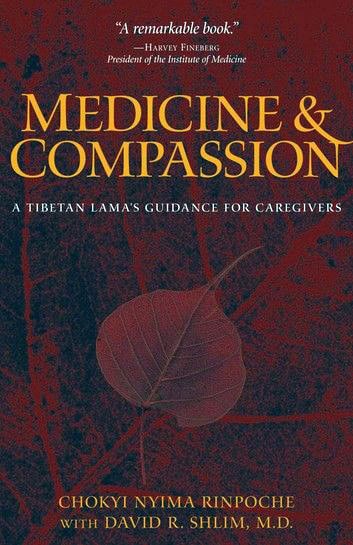
Medicine & Compassion begins with the assumption that most people enter into medicine with the intention to help people and is designed to guide them in how to further develop that motivation. Those in the medical field know that Western universities are good at teaching knowledge, technical skills, and, more recently, customer service—things that health providers need in order to provide quality medical care to their patients. What these educational institutions fail to teach, however, is how to develop and maintain kindness, which can make the difference between treating a patient’s symptoms and adding a profound benefit to a person’s life. This book is the product of edited transcripts from two conferences on compassion in medicine arranged by David R. Shlim, M.D., and taught by Chokyi Nyima Rinpoche. The conference was designed for medical professionals with no knowledge of Buddhism and was not advertised to students practicing the dharma. In the book, Rinpoche makes the case that compassion is a quality that is inherent in all of us, a quality that can be developed and improved upon using teachings and practices given by the Buddha.
From my own personal experience working seven years in the emergency department and three years on an ambulance before that, I realize it can be difficult to constantly hold compassion for patients every moment. Long hours, nights, weekends and holidays in a stressful environment that continually misuses resources takes at toll on my ability to see each person I care for as someone who is wanting to be happy. It can be hard to see my interaction with them as a great opportunity to bring some benefit to their life. Reading this book helped to guide me back to spending the time in awareness of my feelings and to working on cultivating the seeds of compassion in my workplace. I know that when I practice this, I am much more effective, make fewer mistakes, and better enjoy my work.
The book is not only useful for those in the medical profession. Rinpoche uses the topic of medicine to explain both basic and more complicated concepts of Buddhist teachings that are applicable to everyone. In addition, patients and their families may find that the book gives them tools for accepting, navigating, and counteracting the flawed, financially driven culture of the medical establishment, which treats hospitals and doctors’ offices like factories and patients as commodities. I also think that the book will help the reader to become more useful as a patient. As Dr. Shlim points out in his introduction, some of his more profound introductions to Buddhism and its compassion occurred in his medical practice, where he took care of ill and dying Tibetan lamas and refugees in Nepal. Despite their suffering and sometimes terminal conditions, those in his care impressed him with a level of compassion that, in turn, influenced how he perceived and treated others that he cared for. We cannot underestimate the power that we as patients have on our medical providers to influence their outlooks and, thereby, the exponential benefit they provide to others.
The book is divided into three areas, each having short chapters only a few pages long, which make for easy reading. In the first area, he explains human nature, what compassion is, and why maintaining it is difficult. Next he gives us teachings on how to develop the inherent qualities of compassion. Lastly, Rinpoche gives specific examples and situations, such as difficult, dying and angry patients and their families. I especially appreciate how Rinpoche shows us how to transform the byproduct of both being compassionate and close with our patients, and also having to cope with their suffering without shutting down those good feelings or numbing ourselves to their condition.
Medicine & Compassion is not written with a lot of dharma jargon or exotic ideas. The book presents the topic of compassion from a Buddhist perspective in a clear and understandable style for the educated layperson. It is interesting to note that the book has also received reviews from several medical journals, including the New England Journal of Medicine. This shows that the book was found by some medical practitioners to be scientific enough in nature that they could share it with their colleagues. Medicine & Compassion is one more excellent example of how practical the teachings of Buddha are, how they can directly apply to our modern 21st-century world and to a profession that affects everyone.
H.H. the 16th Karmapa Ranjung Rigpe Dorje recognized Chokyi Nyima Rinpoche as a tulku when he was a small boy. He trained at Rumtek Monastery in Sikkim for eleven years and was the personal attendant of the 16th Karmapa. Later, Karmapa asked Rinpoche to build a monastery in Kathmandu, Nepal, and to focus on helping Westerners learn Tibetan Buddhism. Today he has a good connection with H.H. the 17th Karmapa Trinley Thaye Dorje and continues to teach Westerners in Nepal and at his meditation centers all over the world.

