When one hears the Tibetan word bardo, the first thought is of the time after death. However, this word refers to any “intermediate state.” Beings experience little but intermediate states throughout their lives until they attain the state of enlightenment, when mind recognizes its own timeless clear light.
Right now we are in the bardo of being awake. (If I did not bore you to sleep already!) We communicate using the words and symbols of different cultures, and perceive more or less the same world through our senses. At night we enter the bardo of sleep—of darkness and a lack of consciousness. For those fortunate enough to know the Clear Light Meditation well, the experience can be very different, like resting in an ocean of light.

There are also periods when the impressions stored in one’s subconscious surface in different ways, such as while dreaming. This is called the bardo of dreaming and may include most drug-induced states. Then, one changes again to waking or sleeping consciousness.
The mental states mentioned so far are in their essence conditioned and changing, with no lasting qualities. While alive, humans and animals move between these three bardos of waking, sleeping, and dreaming. At death, three further bardos appear.
First comes the process of dying itself and the centering of energies in one’s body. Whether death is quick or slow, this is a profound transformation. After three days of unconsciousness, a period follows where mind continues its habitual flow from the previous life. During the next two weeks, the recognition that one is dead surfaces ever more often. During the last twenty-five days of the seven weeks that the full maturation of one’s subconscious may take, those who receive no help from the outside will see their dominant mental condition condense into one of six states of existence.
This process is timeless in the way that space is without beginning. Mind also has no starting point. The outer world and our inner experiences constantly unfold. They express mind’s unlimited richness in countless ways. Such bardos have always alternated, expressing timeless mind’s flows of causes and effects. Here, the subject is the events around death and rebirth, seen mainly from three unreformed or “red hat” Tibetan Buddhist schools. This view is unique in the world and presupposes an analysis of both mind’s absolute and relative aspects. The key realization is that mind is essentially space, that it does not have color, weight, smell, or size. That it is not made of anything, was not born, and cannot die. As it did not come from anywhere, it also will not go away.

However, this space is no black hole. It implies neither disappearance nor non-existence. Its nature is rich. It plays, expresses itself, dreams, lets things happen, and then dissolves them again. It has great power and is simultaneously unlimited. Wherever one looks, there is no end to it—more things can always happen. As this recognition dawns, it brings increasing bliss. No conditioned feeling is even comparable. And fearlessness, spontaneous joy, and active, unsentimental, and far-reaching compassion spring from it naturally.
If this were beings’ constant state—always aware of mind itself—dying and being reborn would be like an exciting change of clothes, simply because they show mind’s potential. Mind’s clear light, its radiant awareness, and the joy and power of its activity would never stop to impress. Without any breach of consciousness, and utilizing our bodies and speech ever better as tools for the good of others, we would freely choose rebirths at places of maximum usefulness to all.
This is far from the everyday experience of most, however. Whoever does not meditate will rarely glimpse mind’s essence. In that case it happens mostly by chance, such as in lovemaking, in a fast curve on the motorcycle, or during the free fall before one opens the parachute [while skydiving]. Whoever meditated well in former lives may experience such states when finding inner calm, while chemically altered states may show one the door but cannot take one inside. Whether mind’s eternal freshness manifests through a continuous process of growth or accidentally, its nature is the total certainty and deep joy that appears when one is here and now. When one forgets to fear or expect, mind expresses a love that has few concepts.
Unenlightened beings identify with mind’s stream of impressions and seek a lasting essence in the changing flow of thoughts and feelings that are their own mental activities. Even though experiences may be strong and convincing, conditioned situations and feelings cannot last. On a relative level, however, their nature is similar to a river: though new water flows by constantly, there is still continuity and people identify with their streams of awareness. There is a causal relationship between a child of seven and the later adult of seventy that they may become. Without the original child, there could be no adult later, even though every particle and molecule is new. At a certain point, when the conditions for a body to function fall apart, we meet the process called death.
Seen from the outside, death looks very different, depending on whether one dies slowly from AIDS or cancer, or if one’s body disintegrates immediately due to meetings with suicide bombers or having a high-speed accident. The process that takes place is, however, always the same. Whether it happens in a flash or over a longer time, the energy that was spread over the whole body moves toward its central magnetic axis.

In Far Eastern religions of experience, awareness and energy are seen as interdependent. Therefore, the body is thought of as an energy system, the qualities of which vary depending on the goal. A Hindu here seeks shakti willpower, leading to a formless god state. A Taoist aims for a balanced long life, and a Buddhist wishes to experience mind’s clear light. In Hinduism, one focuses on the nervous energy in the spine. In Taoism, one breathes in an ellipsis that descends down through the front of one’s body and ascends through its back.
From a Buddhist perspective, the central and transpersonal magnetic axis in one’s body lies between a point eight fingers behind the original hairline on the top of one’s head and ends four fingers below the navel in the center of one’s body. From this main energy “tube,” five energy wheels spread out in one’s head, throat, heart, navel, and sexual centers. They branch out into 72,000 energy channels that fill the body. Feminine in essence, they are essentially intuition and space. Within them lie dormant male energies that gradually awaken into compassion and joy on one’s way to enlightenment.
During the dying process, awareness draws back toward the center of one’s body; and then one’s five energy wheels collapse into the central energy channel. As this transpires, we first lose power of the solid body. We feel under pressure, and our sense impressions become unclear. Then, we lose control of the fluid element. We feel as if floating in water and drool from our mouth and nose. Following this we begin to feel dry, and cold enters from our extremities. As death comes nearer, our breathing becomes shallow and harsh; and if we have not meditated, we increasingly lose the ability to focus our mind. Depending on our individual karmas, impressions absorbed during our life may manifest as anything between wonderful states of joyful meaning or intensive states of loss, with fear and frustration. In the end, one takes three very long exhalations, and one is dead.
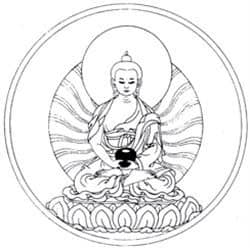
Om Ami Deva Hrih.
Om Ami Deva Hrih.
Om Ami Deva Hrih.
Though metabolism stops at this point, during the next twenty to thirty minutes, an energy process continues inside the magnetic axis of the body. This central energy channel was founded when our consciousness met with the sperm and egg of our parents. The two cells, the genetic information of which supplied the basis for our present bodies, each carry an energy charge. In meditation, the male essence is experienced as white and the female as red.
As billions of cells became our human bodies, the white energy moved upward and is centered about eight fingers behind our original hairline on the crown of our heads. At the same time, the red energy moved down and came to rest four fingers below the navel in the middle of the body. Between these two poles lies an axis with five main energy-wheels. Further wheels and channels spread from there.
During the first ten to fifteen minutes after breathing stops, the white energy loosens its hold at the top of the head and moves toward the heart. On its way down, a beautiful moon-like clear light is experienced, while thirty-three feelings coming from anger disappear. Many hear the sound of a drawn-out HUNG syllable, and memory becomes so intense that one frequently sees beings that have died long before oneself. During the next ten to fifteen minutes, a red light rises from the point four fingers below our navel. The feeling is very powerful, and we experience a light like a deep sunset. While it moves up to our heart center, many hear the deep vibration of the syllable AH. Forty feelings of attachment disappear at this point, and we feel indescribable joy.
Twenty to thirty minutes after death, the upper and lower energies fuse in the center of our chest at heart level, and everything becomes black. As this happens, seven veils deriving from mind’s ignorance dissolve. Shortly after that, the radiant light of all-pervading and beyond-personal awareness appears, and, if we can hold that state, mind experiences no separation between truth inside and out. Its open, clear, and limitless essence pervades all times and directions, a level of consciousness manifested to the awe of hundreds by the 16th Karmapa at his passing during November and December 1981. (See Riding the Tiger by Ole Nydahl, Blue Dolphin Press, Grass Valley, CA, pages 178-214.) This condition is often compared to the meeting of a child and its mother, and whoever can hold this light will experience the limitless awareness and highest bliss of enlightenment. All separation between space and energy, here and there, past, present, and future then falls away.
The majority cannot hold this level of integrity because they didn’t train their minds, became politically correct, or otherwise obscured their awareness. They then black out. The Tibetan Book of the Dead mentions a period of three to four days of unconsciousness after death. However, in cases when dead people have come to me—transparent but looking in all other regards as they normally would (see Riding the Tiger by Ole Nydahl, Blue Dolphin Press, Grass Valley, CA, page 271)—it has always been after sixty-eight hours. I think this is because they were all highly educated city people— with quick mental processes.
When mind re-awakens after unconsciousness, there is the feeling that something is fundamentally wrong. Even if the body lying there is still intact, one will avoid looking at it and will try to get away. This state is most confusing because due to the lack of being anything solid, we appear at whatever place we think of. Our intelligence is also much sharper when we are dead. We “hear” whatever the living think as if they were saying it, which may bring some surprises, but we cannot communicate with them. When sitting on a chair, people will sit on us, and when we try to talk to them, they walk away. In spite of all of these signs, especially those who died suddenly, we avoid recognizing that we are dead.
After the three days of unconsciousness, a week follows during which people still experience the habit-world of their past life. Then, however, it becomes impossible to ignore the realization that we no longer have a physical body. This recognition may strike when once again we stand in front of a mirror and see no reflection, we discover ourselves walking on fine sand without leaving any footprints, or we put our hands in boiling water and do not get burnt.
The realization “I am now dead. I do not have a body anymore,” is such a big shock that one falls unconscious for a second time. Then mind awakens again, around the tenth day. During the next two weeks one’s habitual mental program alternates with one’s subconscious impressions from the last life, until around the twenty-fifth day. Then the strongest tendency becomes dominant, and if no lama’s blessing or meditation habit from last lives intervene, within a total of seven weeks after dying that will determine one’s next existence. What makes breaking that chain so important is that any conditioned state contains pain. It is much less than the emotion-free state of liberation and does not even touch ignorance-free enlightenment. Since mind is essentially space and has always been playing, bringing forth the inner worlds of experiences and the outer ones of phenomena, understanding the conditions at work help one bring both others and oneself to the level of full functioning.
Here is an overview of the six psychological realms of existence experienced as the maturation of beings’ karmas at rebirth.
Though the desire-dominated human realm provides a wide range of karmic effects, from the suffering people in poor and suppressed countries to the free and luxurious Western suburbs, the power of the states experienced is weakened through one’s sense impressions. Also the experiences of animals are thereby muted, while the four other non-human realms of existence that may appear from mind’s stored tendencies experience joys and pains much more intensely.
Three levels of existence appear from dominant pride. Massive good actions combined with the power of abstract thoughts bring about four so called formless god-realms. Combined with aesthetic sensitivities, they produce seventeen so-called “formed” realms, and with desire they become six states dominated by sensual pleasure. Only in tandem with the understanding of non-ego do good actions become liberating. Otherwise, their good effects are spent, and other less pleasant psychological states take over.
If jealousy manifests as beings’ main feeling, they may find themselves in weapon chambers. In former times they would have looked for swords or spears, but today it would probably be machine guns. Bombs for suicides would be found in the very lowest department. These beings have serious inferiority complexes and are deeply disturbed when others enjoy more happiness than they.
If confusion from many lies surfaces as the strongest disturbing emotion, mind may try to hide among rocks and bushes. If animals go there to mate, one may make the mistake of going between them. Thus, one will end up with four paws and a genuine fur coat for both summer and winter.
If greed predominates, already during this life it makes beings miserable. The more some people have, the stronger their possessions imprison them. After death, this general frustration condenses into an intense craving for food and drink. Some then experience their bellies to be as big as towns while their mouths are like the eyes of needles. Others may feel any nourishment discovered as being hot like fire or that unpleasant spooks snatch it away from them.
However, mind’s worst pollutant is hatred, anger, and ill will. If not purified, these feelings will mature as heavy paranoia. The traditional texts distinguish between eight levels of pain deriving from heat and eight from cold. They are not worth visiting! In addition, there exist the so-called “neighboring” and “sometimes” states. The latter two also appear in the human realm as beings inflicting and experiencing massive suffering.
As mentioned earlier, desires brought about this present human life. They continually and strongly influence it. Also, karma is ongoing and has wide-ranging effects. It produces the realms of beings’ rebirths. It also determines the kind of body one gets, the environment into which one is born, and the motivation bringing about the actions leading to one’s next existence.
Yet, we have the controls in our hands. Having the ability to imagine transpersonal states, liberation and enlightenment are possible to humans. Furthermore, until mind’s abstract power arises, one may work skillfully on the relative level. Doing what is useful and avoiding harm, one may inspire others to experience and also share the best of the impermanent happiness inherent in mind.
Even humans have the four basic problems of birth, old age, sickness, and death with which to contend. The best years of one’s life are characterized by the difficulties of trying to get what one wants, avoiding what one does not like, holding on to what one has, and arranging oneself with whatever cannot be avoided. This cycle of existence has been going on since beginningless time, and it is important for us to find lasting values.
All Diamond Way Buddhist meditation practices aim to make radiant awareness ever present. If we meditate, we can enter a state that is timeless clear light in essence—awareness independent of anything, beyond birth and death, without coming or going. If we use our precious opportunity, the after-death bardo states can become our gateways to enlightenment. They give us our best chance to confront mind with its true nature and to set it free.