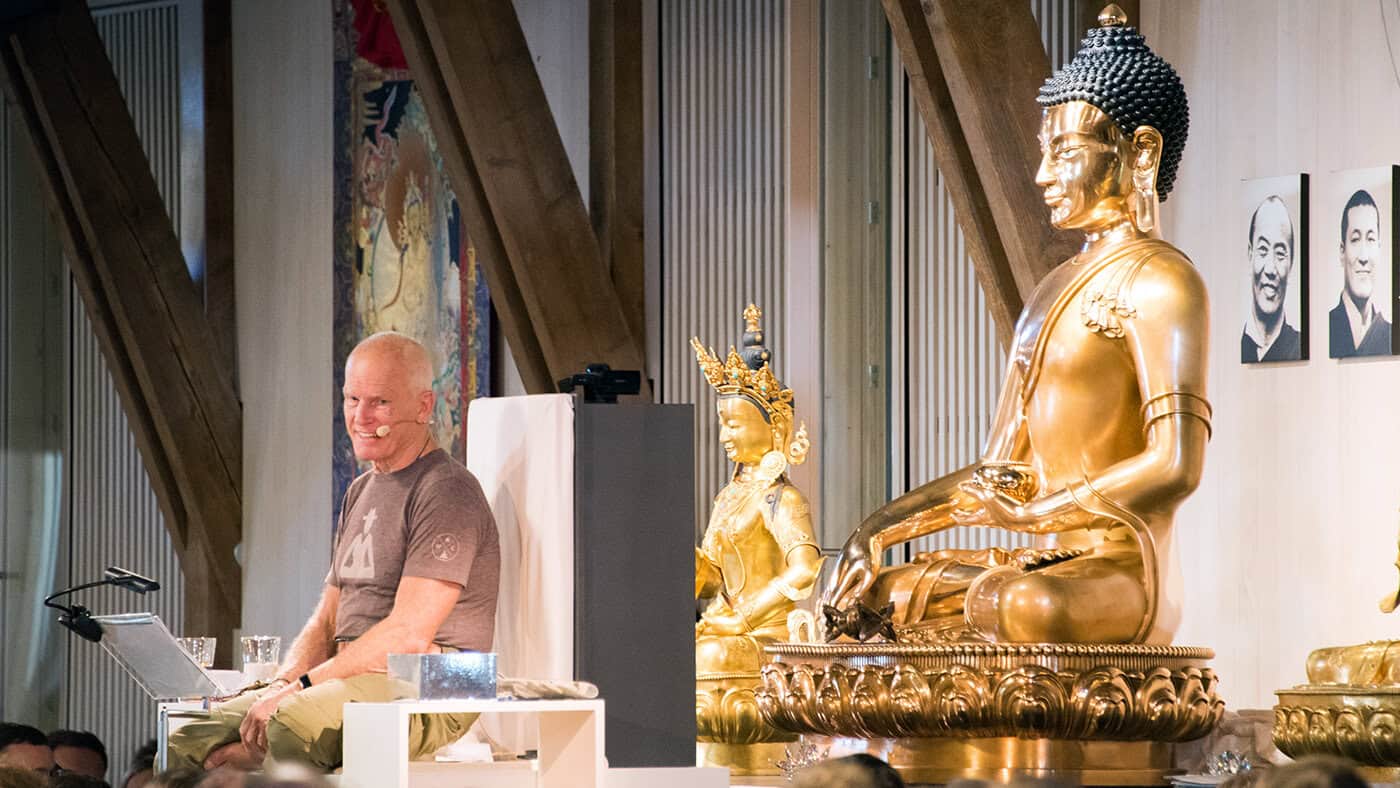
Esotera: The central spiritual figure in your life, the 16th Gyalwa Karmapa, died last fall at the age of fifty-six of heart failure in a Chicago clinic. Are there any explanations for this early death, other than purely organ failure?
Lama Ole Nydahl: Yes, there are many reasons. It was actually technically the right time. First, the Karmapa, like all high bodhisattvas, used his body to absorb as many negative energies out of the world as possible. There are meditations where one visualizes one’s own body as a whole universe, and then, one can take upon one’s self much negative energy that would otherwise touch many other beings in the form of difficulties, illnesses, etc. In fact, the Karmapa was suffering from six to eight deadly illnesses at the same time. He was completely afflicted with cancer, had liver failure, kidney failure; so about everything you can die of. To die at that time and in that place was his own free choice. A year and a half before, he had already told Hannah and me that we should come to him on that November 1st and that we could bring our friends with us. We both had the feeling that it was to say goodbye.
And he did not have the strength to rid his body of the disease?
It was not so meaningful. He is not alone; he has four young incarnations (tulkus) with whom he is reborn alternately, and they are now all thirty years old.
So if he comes back as a twenty-year-old to fully take over the lineage, then at that point, they will be fifty years old. If he had died during the flight from Tibet, most of Tibetan Buddhism would not exist today. Our few hundred centers in the world would not exist at all. If he had died twenty years later, then the lamas would have been about seventy years old at the time of his return as lineage holder. So, although it hurts us all very much that he has died—we were all very attached to his big, warm, fun body— technically it is absolutely the right time for the transfer.
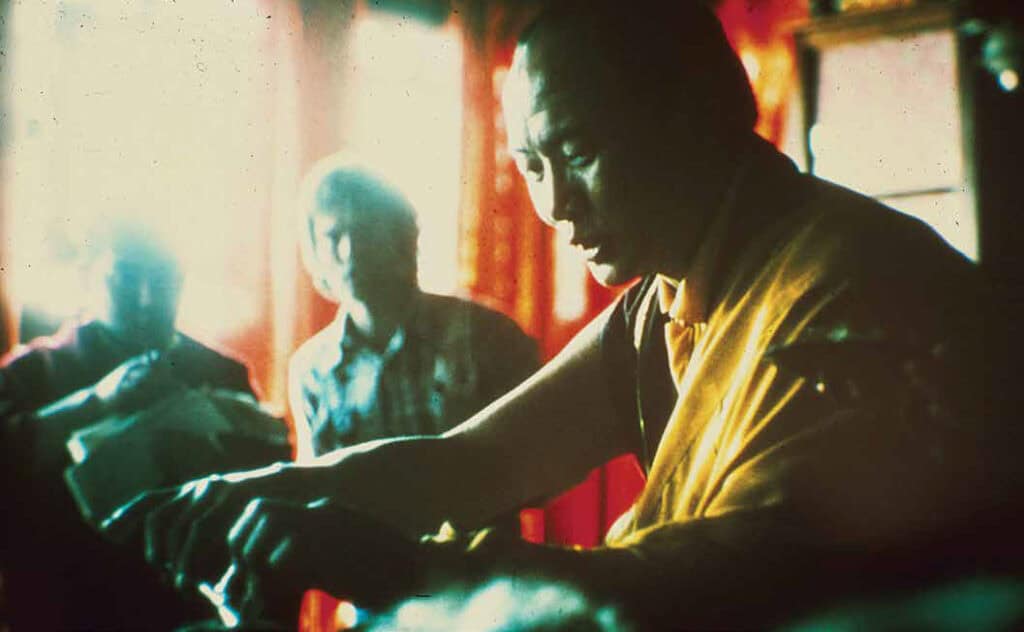
The fact that he died in Chicago also makes a lot of sense. Chicago has the largest slaughterhouses in the world, and I have seen more unhappy and sick beings in Chicago than anywhere else before.
So, by dying there, he was able to liberate many beings?
At least he absorbed a lot of negative energy from people. I have seen him do this in the past, and I am quite sure, as the great lamas say, that there will be great progress in the future in the treatment of the diseases he died of, such as cancer, etc. There will soon be turning points.
You were present at his funeral ceremonies. What happened there?
Oh, a lot happened. Hannah and I were his first Western students, and since 1969 we have often seen him and we’ve seen him play with the so-called laws of nature many times. But what we experienced this time, after he left the body, we had never encountered that before. After his death on the night of November 5, he sat in meditation for five consecutive days without his body becoming cold or stiff.
But clinically, he was already dead?
Yes, his body remained warm without any brain or heart activity, especially the heart center. Again and again, the doctors noted this. That was, of course, also a reason why he died in the West. Then he was flown to Rumtek (Sikkim), where we waited for him with 101 friends.
We could see him being placed in the large mandala without embalming. I was among those who carried him into the monastery courtyard. After five days, when I leaned my head against his foot, he was still warm. This, of course, is most unusual. He was then placed in a meditation position (again without being embalmed) in a warm room, and during the forty-five days that he was left there, until December 20, when he was cremated, the body had shrunk to the size of a small child, about fifty centimeters tall at the end.
A thin scarf was hung over his face, but everything was still fully visible, eye sockets, etc. I witnessed this, other people who were there did too. When the puja was finished, a huge, perfectly round rainbow (of which there are photos) appeared around the sun; it was seen quite clearly. Then, for a short time, there was nothing, and when the fire was set, this rainbow came out very clearly once again. At first, the body would not burn properly, and the smoke went in all four directions of the stupa (where it was burned), which is considered a blessing by the Tibetans. After some time, when one looked into the burning place through the upper holes, it was suddenly empty.
Then a lama passed by the stupa, and at that moment a ball came flying out of the observation window. It was examined and it was found that it was hard on the outside and inside it was soft. With time, it became smaller and smaller, dematerialized, so to speak, and this did not come from the heat, because the ball was already outside the fireplace. The Tibetans say that the dakinis, the female buddhas, who don’t think much of us humans, steal the essences of enlightened beings and take them themselves. This ball was obviously the heart of the Karmapa, and as it became smaller and smaller, they covered it up and moved it to another place. It now serves as a relic and is used to bestow blessings.1
During the burning I also had psychological experiences that were completely new. I never have desires. I am a man without desires. What is happening in the world is so exciting and fantastic, how can I improve on it with wishes? The Buddhist wishes for the welfare and enlightenment of all beings I have, of course, but otherwise none. At that moment, however, an endless stream of wishes came up in me, and afterwards I realized, and still do, that each one of these wishes came true.

One week after the cremation of the Karmapa, on December 27, the stupa was opened. At that moment, a huge eagle came, circled over the site for a while, and then flew directly west.
The ashes contained a great many relics. For example, I found some small gold and silver metal balls in my ashes, and the ashes produced more of them afterwards, so the power field has continued to be alive.
So these are miracles?
Yes, most definitely. But with the advancement of science, what we call miracles today may be explainable in a few years.
Are the Tibetans interested in having these things explained scientifically?
Yes, that is why the Karmapa died in the West, I am sure. He really wanted people to think about his death meditation. Bridges to the West will definitely be built here.
Do you see the possibility and necessity of creating a new universal Buddhism in the West in which ethnic components (Tibetan, Japanese, Chinese Buddhism . . .) no longer play a role?
That is what is already happening. We are in the process of cutting off the old braids2 and adopting what is really important and meaningful from Buddhism: the knowledge of the absolute essence of mind on the one hand, and the mantras and various forms of meditation on the other. What has to do with the respective cultures slowly filters away. The best of the East is to be united with the best of our (Western) culture.

Are there no fundamental differences between the various forms of Buddhism? How would you distinguish Tibetan Buddhism from Zen Buddhism, for example?
I would say that what is called Zen in Japanese and Chagchen and Dzogchen in Tibetan, or the Great Seal and the Great Perfection are the same thing. Tibetan Buddhism works additionally with visualizations and inner energies, but the essential recognition of the essence of mind is the same.
Despite the openness for meditative experiences, many seekers of Tibetan Buddhism are initially confused by the numerous gods and bodhisattvas. Is the archetypal world of the Tibetans accessible to us without further effort?
There are, of course, difficulties for some people who start with something as rich as Tibetan Buddhism. If they arise, however, it is the fault of us, the teachers. When people are faced with the large number of subconscious methods, such as the various meditation buddhas, etc., we have to teach them that they all have the same meaning; that they are all just different tools that represent our respective neuroses on a pure level.
And there, where one mixes and blends the impure confusion of our own mind with these pure levels of consciousness again and again, there the different enlightenment processes arise. But one actually needs only one thing.
And it is our task to explain to the beings, when they come to us, what helps them, just as one needs only one particular remedy from all the remedies in a pharmacy.
And the lama is able to find the right prescription?

Yes, but of course one has a feeling for it oneself. Some are dominated by attachment and desires, others by reluctance and anger. Some are simply confused, and do not know what they want to have or not have. Depending on how the mind works, one then finds a peaceful, wrathful, or unified form as the focus of one’s meditation.
We live in an age of therapy. To what extent could Tibetan Buddhist meditation techniques be considered therapeutic?
When a person becomes a master over his own mind, when the layer between the subconscious and the conscious is removed, that is the goal of development.
One often hears in this respect from the Western side that for people who by nature already have only a thin layer between subconsciousness and consciousness, there is a danger of slipping into the realm of psychosis, i.e. flooding the consciousness with the content of the subconscious.
I am not familiar with such cases among our friends. We consciously work step by step. First of all, the right view has to be developed. When the right view is there, that is, when we recognize the essence of the conditioned world; we take what is called refuge. We open ourselves to the different Buddha energies and are protected by them. Then we work first with peaceful aspects that do not cause psychological shocks.
We build them up, dissolve them into light, and merge them with ourselves on a peaceful level. Gradually, we move on to the wrathful aspects, recognizing that ultimately the one who sees, that which is seen, and the action that is done, are one.
So this access to the subconscious is safe?
It depends on what you bring with you. After all, you come to the teacher, to the lama, and you don’t make your own meditation.
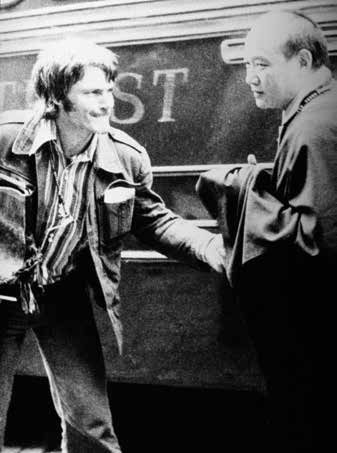
Our task is to find out what the individual can use. Some come because they have some big problem that hurts them. Others come because they have developed so much surplus that they can impart wisdom and compassion; compassion that becomes so strong that all boundaries and divisions disappear, and wisdom that shows that it is only natural to be good, since we are all one.
So, instead of sending a troubled person to some therapist or psychoanalyst, you would rather send him to the lama?
The lama knows the whole path, and one can only give or teach as much as one has understood. The lama has a direct experience of mind either through his retreats or special transmissions and blessings, or through meditations in past lives.
He experiences his own mind as open space, luminously clear, and beyond all limits. By experiencing that the mind is open like space, one becomes fearless, for space cannot be disturbed; experiencing that it is luminously clear, one feels light and joyful, for in this openness so many possibilities are at play, and out of the limitlessness one experiences love and compassion. To a therapist and analyst, since he is interested in the mind, all these possibilities are open.
In the Bhagwan3 movement, for example, religion and therapy enter into a connection that is particularly difficult to define. How would one view the Bhagwan phenomenon from the Tibetan Buddhist perspective?
He is not known there (amongst Tibetans) at all. It’s an Indian trick to let oneself be credited by everyone. For example, Bhagwan’s story that he meditated with the Karmapa in past lives is simply false. The Karmapa does not know him at all. I know this as his disciple. But on the other hand, when Bhagwan does something good for beings, then of course the Tibetans are also happy. I am happy about it too, but I don’t know enough about what he is doing, so I can’t say that much about it.
Everywhere today there are prophecies about an imminent end of the world, but also a new savior. What do the lamas say about this?
The lamas emphasize that it is important to learn to handle the mind consciously now, because in future years it will not become easier. There is no talk of a really big end of the world, but that there will be more and more discontent, confusion, suffering, and disturbing feelings seems obvious. The lamas explain it—the Karmapa himself has often put it this way— by saying that in addition to the basic feelings, which always remain the same, the layer of undigested information, of unused material, of things that work unconsciously in the mind, is stronger than ever before. This is what needs to be worked on.
How important is the study of Buddhist philosophy for authentic spiritual experience?
Within Tibetan Buddhism, there are four schools that are suitable for different people to help them. Some are more intellectual, dry—that’s very important for certain people— others, such as the one I represent, the Kagyu school, which is the most widespread in the West and for which I travel constantly, works on the premise of a fundamental, deep trust with the direct transmission of spiritual experience.

The teacher can transmit something directly to the student through the flow of his energy. When the highest teachings of the Diamond Way, with which we work, are understood, the rest falls freely into one’s hand, just as when one conquers the king, one possesses the whole country.
So one can experience the main part of the teaching through transmission, intuition?
Through transmission and a certain degree of knowledge. You have to know that the mind is not just some thing, and you also have to be beyond the belief in your own separate self.
In your opinion, is Christianity coming to an end?
I think Christianity has many aspects. One aspect which is certainly not at the end is that of healing. For example, many healings and miracles are still being performed in the name of Jesus. I think that for people who don’t want too much philosophy and can develop a lot of devotion, Christ is still very useful, especially when you free yourself from the limiting principle of being the “only true religion and salvation.” Once, when missionaries came to the Tibetans and told them about Jesus, they said, “A great bodhisattva, already he can do so much.” Then, when the miracles were reported, they said, “We believe it, it must be true.” The missionaries wondered, “Yes, then you are Christians!” “No,” replied the Tibetans, “because the yogi a few houses away can do the same thing.”
Where Christ appears as a great teacher and bodhisattva, he is very useful, but where he is seen as the only one, the redeemer, etc., he is no longer so modern.
Another private question. You are now a real wandering lama, you travel a lot, you are actually on the road all the time. Nevertheless, you are also married. Don’t you miss your wife?
Yes, we miss each other very much, but we are really like twins. Her function is to travel with traditional Tibetan lamas and to translate for them, and I sometimes experience directly what she is translating when it suddenly appears in my talks, as if by itself. She also experiences my states of happiness when I am with many friends, for example. It works between the two of us. Nevertheless, I miss her presence very much, of course.
What are your next travel destinations?
Denmark, Sweden, Norway, then southern Europe again, South Africa, North America, South America, East Asia; invitations come from everywhere.
Is it still important for you to travel to Tibet or Sikkim?
The high lamas come here all the time. My friends live there, but my teachers all come to the West.
The original interview was conducted in German and was translated to English by Bruce Underhill.
- At the time of the interview, the relic was kept in Rumtek and it was possible to see it and get a blessing from it. ↩︎
- The German idiom of “cutting off old braids (hair)” refers to turning away from outdated institutions and ideas. ↩︎
- The Bhagwan movement was inspired by the Indian mystic Bhagwan Shree Rajneesh (1931–1990), also known as Osho. It was significant at the time of the interview in both Germany and parts of the US. ↩︎