
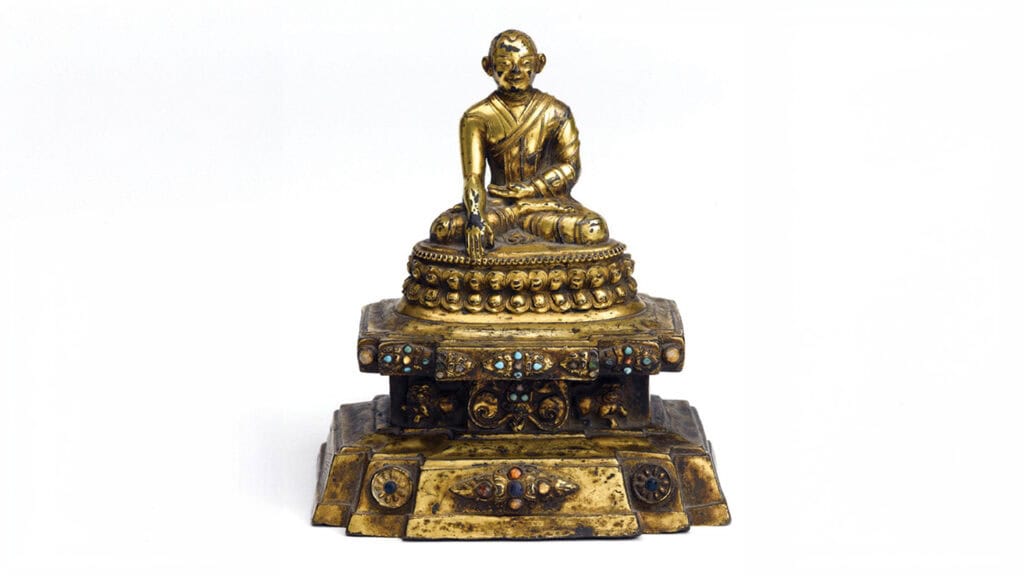
At the very beginning of the Karma Kagyu lineage in India, one of the first teachings given directly from master to student was Tilopa’s invitation to Naropa to jump from a roof. After such an unusual start, it was clear that the history of this lineage would not be uncontroversial and mild. Even the appearance of Gampopa, who was exceptionally gentle, didn’t change the basic outlook of the Kagyu lineage, since the man who took over his role—and he was not the first Karmapa as one might have expected—became famous for his scandalous behaviour, a lama who gave the highest teachings, who wouldn’t be forgotten even until the present.
He was called Lama Shang and was born in 1122 into the Tibetan Nanam clan. His mother Shumo Zamagkyi was a nun up to the moment when, persuaded by her realized teacher, she married her husband Shang Dorje Sempa. The family got the nickname of Shang, which literally means ‘uncle’, because a lot of women from the family were married into royalty.
Since early childhood Lama Shang had been spontaneously considered a tulku and was constantly asked to give blessings. He received a fair education in classical texts on Buddhist philosophy. Later in his life he used to say—tongue in cheek—that he understood nothing from them in order to stress the importance of formal meditation practice which became his main speciality. He meditated very successfully, which was confirmed by visions of meeting with yidams, auspicious dreams and all kinds of signs.
At the age of fifteen, he had already had deep meditation experiences, but three years later his unruly temper took over and resulted in his studies of black magic. As with Milarepa, black magic was supposed to be a tool to help solve family problems. After a few years spent in Kham, he took monk’s ordination which didn’t prevent him from continuing to engage in black magic, bringing a bad name to his family and giving him the reputation of being a great magician in Central Tibet.
Finally, when he was 25 years old, he took ordination again and started to practice, wandering alone across Tibet. His main teachers were Ga Lotsawa Shonnu Pal, Mal Yerpawa and Dagpo Gomtsul. From the first he got the transmission of the Six Doctrines of Naropa together with crazy wisdom teachings, destroying his pride. From the second, who was a student of Rechungpa, he received further teachings on the Six Doctrines. He became so successful in practicing them that he melted a huge amount of snow around his hut, flooding the village below. The local people had to ask him to stop practicing inner heat, because the water destroyed dams around their fields.
The third teacher of Lama Shang—Dagpo Gomtsul—was the student and also nephew of Gampopa. He became Lama Shang’s main teacher and passed on Mahamudra to him. Only through this practice did Lama Shang begin to consider himself a real practitioner. He became convinced that they were the only teachings worth passing on. Their directness and powerful impact made everything else he had practiced before seem superficial. He practiced them alone, high in mountain retreats, with a diligence like that of Milarepa.
Developing peace of mind
Developing spiritual experiences
Developing deep states of meditation…
That is ordinary.Through the lama’s blessing,
Lama Shang (1122–1193)
Letting realization emerge
from within…
This is extraordinary.
The enlightenment of Lama Shang is described beautifully: first meeting with Padmasambhava, then Mahakala and Vajrayogini in Bodhgaya, from whom he received wisdom nectar to drink. Later, in union with Vajrayogini, he became all-knowing by going through all her energy centers and being born again after experiencing visions of thousands of worlds where hundreds of his own forms were transformed into Vairochana giving teachings.
Lama Shang—wanting to spend the rest of his life in retreat—asked his master Gomtsul for advice, who responded that his activity was definitely needed in the very center of Tibetan society. That is why Gomtsul gave him the title of the ‘Lord of Dharma’ in Jokhang and later made him responsible for the renovation of this most holy place in Tibet (along with Ramoche Monastery, destroyed in local clan wars).
This is how Lama Shang became a socially and politically engaged teacher, whose highest teachings, passed on in a very approachable way, would reach students representing all classes of society. The highest teachings again found their place at the center of Tibetan society, provoking enthusiasm in his students and resistance in many other lamas who didn’t agree that they should be spread so widely. He was criticized for transmitting the deepest teachings too quickly: according to more traditional teachers, they should have been given only to a very limited and chosen few, and only after very long preparation. Lama Shang couldn’t imagine to keep the most direct teachings secret.
In the meantime, his rough friendship with the first Karmapa was blossoming. Not very much is told about their relationship in the texts, but from a few descriptions we can see them both as rough yogis treating each other without any sentimentality. Once Karmapa, during an official statue consecration ceremony, lifted Lama Shang and with all his strength threw him at the statue, shouting “Melt together!” Or we read about Lama Shang hitting Karmapa three times in public, while the latter explained to the terrified audience that his life had just been prolonged for three years. This kind of testimony shows very deep bonds between them, beyond the concepts of even those who witnesses these incidents. Karmapa himself remained the only one who could tame Lama Shang, causing him to withdraw from battles and fights which he was soon to undertake.
The reason for these battles was that Lama Shang was responsible for guarding and upholding the law of the country. That is why very soon he had to stand on the battleground together with his troops. This was a situation which suited his Marpa-like temper and he became a very successful commander-in-chief, with one victory after the other; the relentless guardian of dharma, who even in such extreme situations was able to keep his mind calm and concentrated. His students fighting together with him could witness his rough activity and warcraft filled with compassion, treating every enemy like his former parents. As he used to say, even if among his students he would find all his enemies, he would not stop giving them empowerments. The most unique empowerment for his students was fighting together with them, arm in arm. There, exactly in the middle of battle, they experienced flashes of insight, starting to realize what Lama Shang was talking about in Ultimate Deep Path of Mahamudra:
It is not matter; it is self-aware and spontaneously luminous.
It does not exist like a thing; it is empty of colour, shape and size.
It is not non-thing; it manifests in many various ways through conditions.
It is not permanent; it is empty of nature.
It does not disappear; in its nature it is self-luminosity.
It does not exist like a substance; if investigated it has no essence.
It is not non-substance; it is great substantiality free from mental elaborations.
It does not exist as extremes; devoid of any clinging.
It does not exist as a middle; lacking any referential points.
It is not indicated by example; not to be understood by defining.
It is not without example; it is like space.
Not established by words; not spoken about in expressions.
It is not without words; it is the cause of every expression.
“Existing and non-existing, true and false,
Empty and non-empty, peaceful and peaceless,
With mental elaborations and without them,
Conceivable and inconceivable,
Joyful and full of suffering, visible and invisible,
Dual and non-dual, transcending intellect and not transcending
Devoid and not devoid, established and non-established,
Pure and impure, spontaneous and not spontaneous.”
These kinds of words do not capture it!
It is not matter; it is self-aware and spontaneously luminous.
It does not exist like a thing; it is empty of colour, shape and size.
It is not non-thing; it manifests in many various ways through conditions.
It is not permanent; it is empty of nature.
It does not disappear; in its nature it is self-luminosity.
It does not exist like a substance; if investigated it has no essence.
It is not non-substance; it is great substantiality free from mental elaborations.
It does not exist as extremes; devoid of any clinging.
It does not exist as a middle; lacking any referential points.
It is not indicated by example; not to be understood by defining.
It is not without example; it is like space.
Not established by words; not spoken about in expressions.
It is not without words; it is the cause of every expression.
“Existing and non-existing, true and false,
Empty and non-empty, peaceful and peaceless,
With mental elaborations and without them,
Conceivable and inconceivable,
Joyful and full of suffering, visible and invisible,
Dual and non-dual, transcending intellect and not transcending
Devoid and not devoid, established and non-established,
Pure and impure, spontaneous and not spontaneous.”
These kinds of words do not capture it!


