

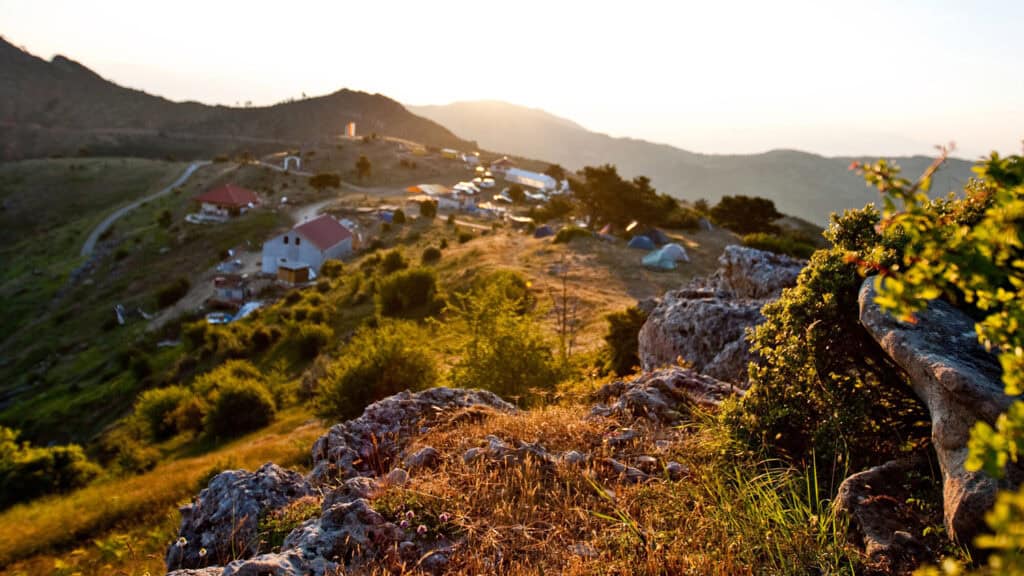
Ever since it was discovered and purchased in 1987, Karma Berchen Ling has held a special place in the hearts of many Diamond Way students. Some call it a wild yogi place, others remember all the obstacles they encountered on their way there, and to some it simply feels like home. Whatever the perception, until last year no more than 300 people at a time had visited this incredibly beautiful place in the Greek Peloponnese.
Over the years, Berchen Ling has hosted many programs with some of the highest Karma Kagyu lamas, including a Phowa (Conscious Dying) course, initiations into various Buddha aspects, meditation and work retreats. What made the summer of 2010 different, and brought more than 2,500 people together to the Corinthian highlands of Berchen Ling, was the inauguration of the first Kalachakra Stupa in Greece. The vision for the stupa was conceived more than twenty years ago by our beloved teacher, Lopon Tsechu Rinpoche. Seven years after his passing, it was again his activity that brought together so many to celebrate his legacy and build a most auspicious monument for the protection and the benefit of all beings.
Stupas are Buddhist monuments that express the nature of mind in a profound way. They bring protection and peace, and increase the wellbeing of the area and even of the entire universe. On an outer level, they represent the Buddha state and the steps to full enlightenment. On an inner level, they give practitioners the chance to make offerings to their own perfect nature and thus clear negative impressions from their minds. The opportunity to participate in the building of a stupa is very precious and leads to the fast development of all involved. Whether one contributes directly to the construction process, or simply makes strong wishes to be connected to that power field, opening up to the timeless values embodied by the stupa makes one’s power and maturity ripen.
There are different types of stupas depending on the various Buddhist traditions they represent. In Tibet, some of the most prominent ones were the Eight Tathagata Stupas, which commemorate significant moments of the Buddha’s life. Kalachakra stupas fall into an additional ninth category and have the special function, according to Lama Ole Nydahl, of “protecting the timeless values of freedom, human rights and democracy against any retrograde forces of suppression which history might bring.” At present we know of approximately ten Kalachakra stupas around the world in various location such as East Tibet, India, Austria, and the United States. Two of them have been built by Diamond Way Buddhists on our retreat lands in Spain and Greece.
The wish to build a stupa in the Corinthian mountains of Greece emerged as soon as Lama Ole and his students visited the retreat place for the first time. At that time, Lama Ole had a vision of the protector Bernagchen and called the land Karma Berchen Ling “the place of Mahakala.” During the first program with Lopon Tsechu Rinpoche in 1991, the idea of a Kalachakra stupa was solidified. Lopon Tsechu said that this stupa will be “of great benefit, especially here in Europe, where there have been many wars, and people fighting and killing one another.” With its location at the southeast tip of Europe, “the place of Mahakala” was the perfect site to build such a monument that guards the freedom of our Western civilization.
For those who have been to Karma Berchen Ling, there is no doubt that this is a real yogi place. The retreat land boasts a beautiful mountain landscape, overlooking three different sea basins and as Lama Ole has said, “unites the richness of Athens and the power of Sparta in a most auspicious setting.” The conditions are perfect for testing one’s mind and endurance: both drinking and washing water are limited, the electricity comes from the power generator lovingly called Jaqueline, the weather changes rapidly with little notice, and attending a course usually means helping to put it together.
Heading to the summer course in 2010, all were aware of the simple and rustic infrastructure of Berchen Ling. Many were wary of the potential lack of water and the hard conditions, and to some that may have even served as a deterrent for coming. As a result, all who came were prepared for some challenges and were thus pleasantly surprised at the ease with which everything flowed during the entire program. There was plenty of water, the weather was sunny, and there was a warm feeling among all course participants. It felt like picking apples in autumn as we were harvesting the fruits of all the good wishes and hard work that our teachers and so many friends had invested in Berchen Ling over the last twenty years.

The group I traveled with arrived at Berchen Ling shortly after midnight on Friday, the day before the official start of the course. It was a long fourteen-hour ride from Bulgaria to Xylocastro, full of anticipation and contained excitement, which got stronger by the hour. The final stretch of driving up the pitch-dark curvy slopes of Black Mountain, feeling the energy build up and hardly talking, felt exactly like the quiet before a storm. And what a storm of friendship, idealism and raw power awaited us!
As we pulled up we saw the faces of the parking sheriffs who made sure we left our cars in the proper parking lot. Yes, in the middle of the wilderness there was that level of precise organization to ensure everything ran smoothly. Getting out of the car we immediately ran into a dozen old friends greeting the newcomers at the reception desk. Another look around showed a perfectly set up dining hall, bright lights shining over joyful campers pitching their tents in the dark of night, and people walking, talking, and laughing—a course site bustling with activity.
The organizers had been allowed to borrow the adjacent parcel of land from our neighbors, so as to accommodate all the people that were expected to arrive. The extra land allowed for an elaborate camp set-up with the meditation hall ( gompa), and the stupa on the hill of Berchen Ling and the dining area and parking on the lower level of our neighbor’s land. The whole area was buzzing with excitement and it felt like coming home to find all your friends were already there. Later in the evening after we had welcomed Lama Ole to the camp, we sat at the top of the hill, marveling at the train of cars that kept on rolling in, their lights illuminating the whole valley.
The next day the official program began with the planting of the Tree of Life ( Bumpa) in the nearly finished stupa. The Tree of Life is the central axis of the stupa and symbolizes the different wisdom aspects of a Buddha. There were already 1,800 people gathered on the hill. The conch shell horns were blowing as the procession slowly moved toward the site. Then Lama Ole, Lama Chogdrup Dorje and his brother, Wojtek Kossowski (the stupa architect) and a few friends who were closest to the project over the years planted the Bumpa inside the stupa. In the celebratory silence, there were radiant smiles glowing on all of our faces. Already the magic was beginning to build!
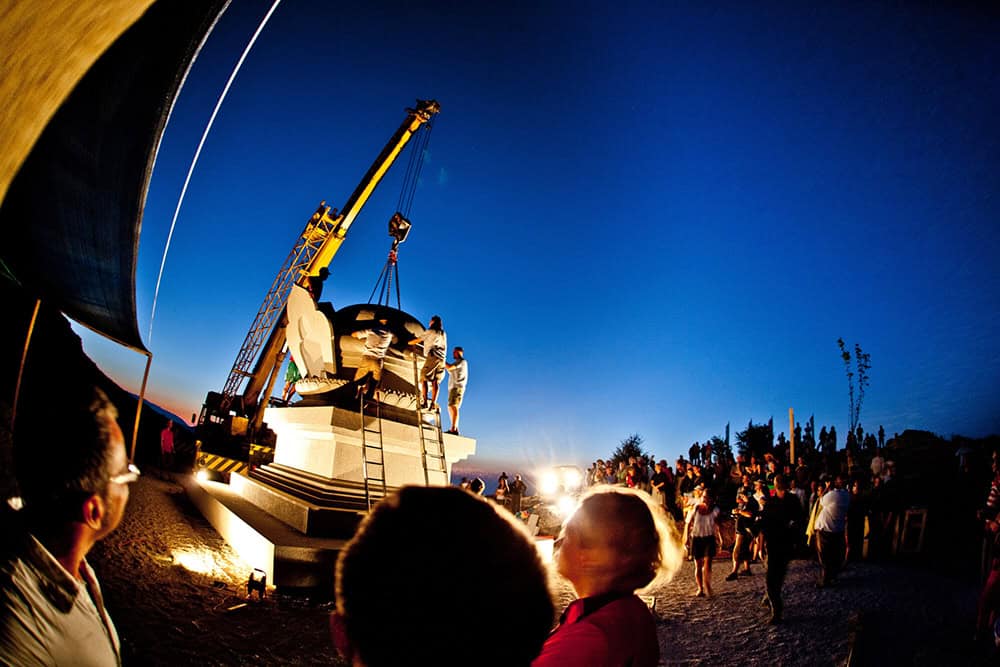
That kicked off the second part of the course, a 48-hour meditation on the Buddha Kalachakra. The Kalachakra Tantra is a part of the non-dual Maha Anutara Yoga Tantra, the highest teachings that the Buddha gave. Literally, Kalachakra means the “Wheel of Time” and is connected to the Shambhala prophecies. To use it as a method, formal initiation and practice in retreat conditions are needed. We felt fortunate to be performing this special practice in connection with the stupa inauguration.
Our lamas led the three official sessions in the gompa every day and encouraged us to keep the meditation going constantly, alternating rest and food with continuously building up the power field around the stupa. Upon leaving the gompa on the first evening, Lama Ole wished, “May you all have a magical night!” And surely we all did. While some retreated back to their tents to get some rest, others bravely stayed at the gompa for the night and kept the mantra of Kalachakra rolling. During the whole night there were happy campers going up and down the hill between the two levels of the campsite, earnestly fulfilling the wish to meditate on Kalachakra for the benefit of all.
The following day the meditation continued uninterrupted. At some point we heard the Buddha statue was going to be put inside the stupa in the afternoon and managed to get a very entertaining lesson on the Western versus Eastern view of time. The moment it was announced that this final preparation ritual was to happen, everybody asked “When? When exactly is the Buddha statue going in?” Lama Chogdrup Dorje simply smiled his fine smile and answered, “At the right time.” As Kalachakra also has to do with Tibetan cosmology and science of time, we found this answer rather fitting.
After the second full day of meditating on Kalachakra was completed, at 9 a.m. on the morning of August 23rd, the time had come to gather around the stupa for the official inauguration. With the previous few days of elaborate preparation and the awareness of all the years of hard work that had led up to this special day, everyone was beyond excited to take their place around the finished stupa in the fine company of more than 2,500 friends from across the world. Some had been at the course site for two or three months, setting up the course infrastructure, making traditional clay offerings (Skt. tsa tsas) for the stupa filling, transporting materials and cooking food. Others had arrived that same day just in time for the auspicious occasion. All in all more than fifteen countries from Australia to Venezuela and from England to Russia were represented in the lively body of practitioners, and they had literally used all forms of transportation to get there.
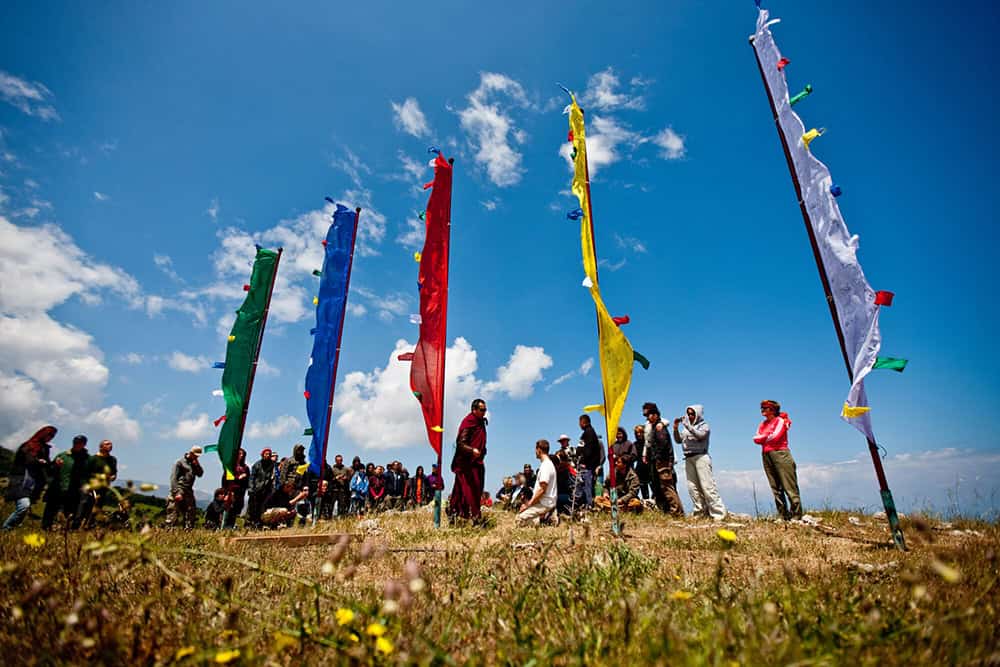
The inauguration began with speeches by the lamas and the two patrons of Berchen Ling, Patricia Schaffrick and Alexander Press. We received explanations on the stupa’s significance and heard the praises of all core team members. Then Lama Chogdrup Dorje began the ritual of the inauguration. The clouds gathered and the sky was dark and cloudy. We all had expected to get nearly scorched in the summer heat and had sunglasses and hats in hand, and were quite surprised by the sudden change in the weather. The moment when the stupa was officially inaugurated though, the clouds above completely broke apart, and the sun came shining through. The sky was totally clear once again!
We passed the balls of yarn from the Buddha statue’s heart from hand to hand so that everyone could hold on to one piece of the thread while making wishes for the benefit and freedom of all beings. Connecting our minds in this symbolic way, all good wishes magnify and strengthen the power of the stupa. We offered rice, had the traditional blessed food offerings (Tib. tsok) and then did our first circumambulations around the inaugurated stupa. All participants received a pendulum marking the auspicious occasion and an image of the Kalackara Buddha form, as well as a blessing from our tireless Lamas. Everyone walked away with the feeling that something important had just happened, and that we all had been a part of it.
In the evening, Maggie Lehnert, who had been the assistant of Lopon Tsechu Rinpoche for many years before he passed away, gave an unforgettable presentation about his life. She told the stories of their time together in such a vivid way that it felt like Rinpoche was there with us the whole time, and everyone was quite touched. And then the party started. We had so much joy to share that the dancing, stories and laughter continued until the crack of dawn.
Over the following three days, Lama Ole led a course on the nature of mind as described in the Great Seal text ( Chag Chen Mönlam or Wishing Prayer of Mahamudra) written by the third Karmapa Rangjung Dorje. During the breaks and in the evenings, we had the opportunity to help with various jobs in the cafeteria and café, all run by volunteers, or simply to enjoy the company of friends from all around the world. The results of more than twenty years of hard work had come to fruition, so this was certainly a reason to celebrate.
Since the very beginning, Berchen Ling has been supported by a group of international friends, each contributing anything from a few days to a few months a year in order to build and maintain the retreat place and develop the stupa project. The main objective of the Greek, Austrian, German, Polish, Bulgarian, Hungarian and other friends who worked together was to build a retreat place on the basis of friendship and trust. The core team was set up on the premise of ‘no hierarchies’ with a genuine openness to learn from each other in every way. The guiding wish was to provide the opportunity for many beings to develop in the power field of Berchen Ling.

Between the time when Berchen Ling was bought in 1987 and the Kalachakra Stupa inauguration in 2010, there had been various obstacles to the development of the retreat place. There were court cases with the local authorities, an arson that burned all of the core infrastructure in 1996, and last but not least, the long eight-year process of obtaining permission to build “a church in the shape of a stupa.” Whatever was built on the site nearly always got destroyed and had to be rebuilt. As a result, many learned patience and compassion while diligently working on the project. In that context, the summer course was the perfect example of how—when we unite behind a meaningful cause with the power of our friendship and idealism—any goal can be reached, and the obstacles become the best tools for our development.
Lopon Tsechu had said that Kalachakra stupas are extremely rare and that many good conditions have to come together in order to build a single one. This became apparent during the long years of preparing the outer and inner conditions for the fulfillment of this project. With the blessing and protection of Lama Ole, whose strong wishes ensured that all obstacles were possible to overcome, and thanks to the joyful effort of numerous friends, our vision became reality.
Building the Kalachakra stupa in Karma Berchen Ling was ultimately the activity of H.H. the 16th Karmapa, who was the main teacher of both Lopon Tsechu Rinpoche and Lama Ole Nydahl. As Lopon Tsechu had pointed out at the inauguration of the first Diamond Way stupa in Spain in 1994: “The possibility to build a Kalachakra stupa here actually goes back to H.H. the 16th Gyalwa Karmapa. It is due to his wishes, it is due to his prayers, that this could happen.”
May all beings benefit and develop in the power field of the Karma Berchen Ling Kalachakra Stupa.


