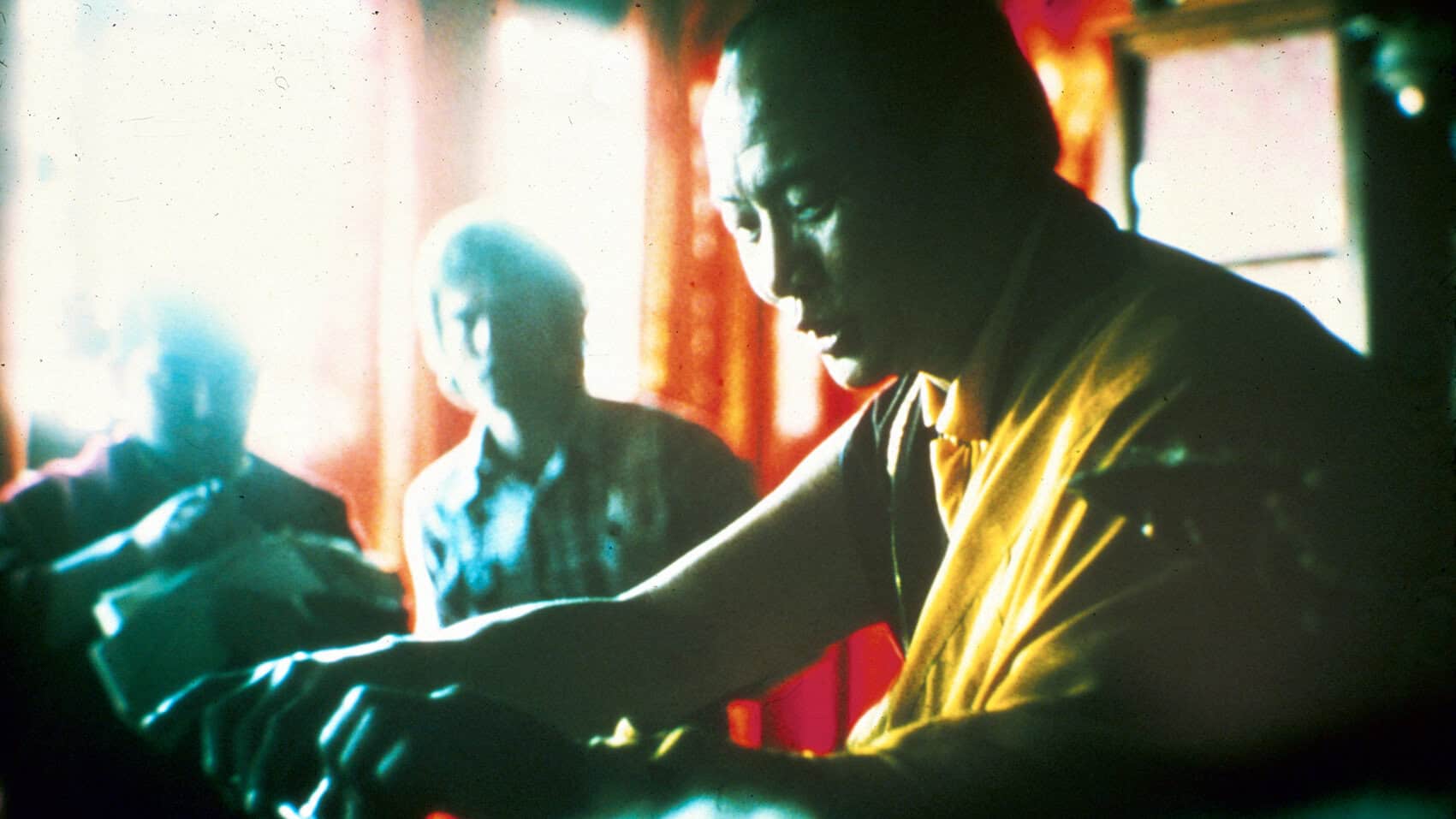
The idea of a spiritual teacher is far from most people’s experience. Many know teachers in school, but not as a companion in ordinary life. However, all people share their desire for happiness. Although an unlimited number of people try to reach this goal, only very few succeed. In Buddhism, we are fortunate to have men and women who know true happiness and who want to share their experience.
There are different kinds of Buddhist teachers. The lineage lama holds all the transmissions of a Buddhist school, whereas the root lama gives special meditations and methods. In this article, I will describe the important root lama that we deeply trust, the one who shows us the clear light of our mind. Because his or her mind is stable and joyful at the same time, we gradually develop devotion as we recognize his or her qualities. A Buddhist teacher is the only one who can guide us to the liberated state he or she has reached.
Buddhist Teachers Differ By Tradition
The traditions and transmissions in Buddhism have developed in various cultural backgrounds, such as Tibet, Japan, Europe, and the United States. Teaching styles differ depending on whether the teachers are monks or nuns, laypeople, or yogis.
In the Theravada tradition, the goal of liberation means that one overcame the illusion of an existing ego. The highest possible realization for Theravadins relates to the first bodhisattva level. The contact between student and teacher is not as close as it is in the Great Path (Mahayana) or Diamond Way (Vajrayana) schools. In the Theravada tradition, the teacher functions as an advisor to students who meditate to develop awareness. The reasons for this are many: A bright student can practice the path of awareness, cause and effect, by oneself, so close contact is not necessary. A teacher needs only to give short instructions about the path and meditation, and the student can follow them on his or her own. Many Theravada practitioners are monks or nuns, who are bound to their vows and therefore practice independently of a teacher.
”To give the students a glimpse of buddhahood, the teacher must constantly demonstrate advanced realization.”
On the level of the Great Path (Mahayana), the teacher is more important. His or her role as an example of compassion and wisdom naturally includes a much closer connection to his or her students and to all other people. Because on the Great Path or Diamond Way level enlightenment is the ultimate goal, the teacher must be a bodhisattva who has overcome selfishness and the idea of an existing ego. This enlightened attitude opens the teacher to others, and he or she patiently supports students’ development with a balance of compassion and wisdom. At the same time, these teachers live a modest life as an example. This requires that they be close to their students. This bond results in faster progress, because students can check their level of realization in every encounter with others, while the teacher supports the students’ effort on the way to realization. Because the students have daily experience of their level of attitude, understanding, and wisdom in relation to others, they need a closer bond to the teacher.
Zen Buddhism belongs primarily to the Great Path, although it also includes some Diamond Way transmissions. In both Soto and Rinsai Zen, the teacher follows deeply rooted Japanese traditions so that a very close and open relationship to any other person is rare. The teacher works with students at some distance because it is natural in that culture, and therefore the only immediate access to the student’s mind is from the level of wisdom.
In Diamond Way Buddhism, the teacher is always a mirror to the student. The teacher must have the highest qualities, because the goal requires the student to behave as a buddha until he or she becomes one. To give the students a glimpse of Buddhahood, the teacher must constantly demonstrate advanced realization.
Kalu Rinpoche said, “The teacher is a living buddha.” The teacher keeps the transmissions of the lineage (teachings/knowledge, methods, and meditations) without any mistake, and simultaneously always holds the bonds to his or her own teachers. The teacher shows the students how to remove veils or obscurations to their own buddha nature, because he or she always speaks in a way that benefits others. His or her compassion and wisdom reach far in support of the sangha; the protection of the students; and the advice that is permanently fresh, motivating, inspiring, surprising, and sometimes concept-destroying. His or her view is beyond hopes, fears, and expectations and is combined with all buddha activities. After long years of meditation and practice in everyday life, the teacher’s mind is pacified; therefore, he or she is always clear and joyful, with complete control of body, speech, and mind. In order to benefit students, he or she has to be intelligent with an up-to-date understanding of the world. He or she uses his or her abilities (Skt. siddhis) with the basis of the bodhisattva promise to work for the benefit of all.
Because the teacher’s mind is completely stable, he or she can give Buddhist refuge. As a holder of the teachings, he or she can give initiations that plant seeds of liberation and enlightenment in the minds of his or her students. Moreover, he or she always blesses them.
At the same time, the teacher always checks him or herself by asking things such as: Was I egotistical? Proud? Am I thinking only of my students’ development? Am I teaching them how to find their innate qualities? Do I still carry my own luggage? Am I still grateful? Do I speak directly into the faces of my students? Do I feel more important than my students? Am I always joyful in my activities? Do I continue to support my students so they become responsible, independent, and strong?
Monks and Nuns, Lay Buddhist and Yogis
Monks and nuns must keep their vows. Whatever they transmit to their students can only be within the range of their vows. Lay people live a life like most people on earth. They have jobs. Many are married or live in partnership, with or without children. Others are studying in schools or universities. Their daily experience is completely different from monastic life. If a teacher has experienced life’s ups and downs, he or she can use this knowledge in teaching. The methods are therefore different from those of monks and nuns. An excellent example of such a life and teacher is Marpa the Translator (1012-1097).
“Because the teacher’s mind is completely stable, he or she can give Buddhist refuge.”
In the world of Buddhism, yogis are the most rare but also the most exciting teachers. Their lives are an example for the highest realization and deepest understanding of Buddha’s teachings. Because the yogi teacher shatters people’s concepts by saying or doing provocative things without regard for political correctness and lives a life beyond all social limitations, he or she is either loved or not accepted at all. He or she instructs on the highest level of the Buddha’s Mahamudra or Maha Ati. Because of karmic bonds and connections, relatively few people have access to these teachings.
Different Types of Students

The Buddha distinguishes two types of students: the average and the above-average student. The Buddha describes the “average” student as one who meditates regularly or from time to time, with some progress, and who can reach liberation in this life.
The Buddha then compares this average student, who practices regularly in the tantra path, to the “above average” student, who follows the Mahamudra path— beyond expectations, hopes, and fears. This student understands everything instantly and will be enlightened in this lifetime.
Students vary almost as much as their teachers. Depending on their culture, education, goals, wishes, and karmic bonds, they can follow the path that has the highest benefit to them. It is comparable to sports. If a person can walk but not run, he or she could hike and improve physical ability and health; but it would be impossible to compete in the Olympic marathon. But a person with natural talent and training as a runner would waste his or her abilities if he or she only went hiking and would need the help of a good coach to excel.
How to Find a Teacher
One usually doesn’t look for a teacher, but rather finds a teacher. Bonds from former lives, current lifestyle, and other conditions lead one to his or her teacher. The first teacher encountered will not necessarily be the right one.
For example, in a small town with one Buddhist center, a person who is more attracted to Zen might visit the town’s Diamond Way center. But after some time practicing there, he or she will eventually and naturally meet a Zen teacher and follow him or her. For some people, this “search” may last twenty years or longer.
When one has actually found his or her teacher, everything between them is beyond any doubt. The student brings devotion and karmic bonds, while the teacher can see, simultaneously and with compassionate understanding, all the qualities in the student and the future of their connection. In rare cases, if the bond between the teacher and student is too weak, the teacher will send the student to another teacher, because he or she sees the potential for more beneficial cooperation there.
Reading the life stories of the Mahasiddhas, one quickly understands that a student can have several teachers. This means that even if one feels devotion to a teacher now, in twenty-five years it might be completely different. Sometimes a teacher will send a student to receive certain transmissions from another lama, as when Naropa sent Marpa to Kukkuripa, Maitripa, and other teachers.
Meeting his or her teacher is itself a big step on the student’s path. Deep trust arises, beyond all former experiences with any other human being, with a feeling of finally coming home. Of course, it can take time before all doubts about the teacher disappear. But, if it happens that even the tiniest residual doubt is vanquished and the student sees the teacher as a living buddha, he or she has actually found his or her teacher. From this moment on, the student understands his or her own concepts and is open to all future experiences. As it is traditionally described, one has really found a teacher if one has tears in one’s eyes when merely thinking of him or her. In today’s modern world, one could perhaps say: When the student has found the teacher, he or she simply knows it, without any doubt.